This post was originally written on 2026-10-04. After a long hiatus I decided to get back into the spirit of Technology is Magic – this time with a press review.
September in Magic
Low-Energy Golems: Scientists from Oxford demonstrate the viability of controlling robots via reservoir computing (RC) in particular a system in which the reservoir is a dynamic system expressed by water waves. The authors train the RC-system on a real pool of water agitated by robotic flippers. The entire system needs only the reservoir and a simple/shallow network to exhibit obstacle avoidance Article link.
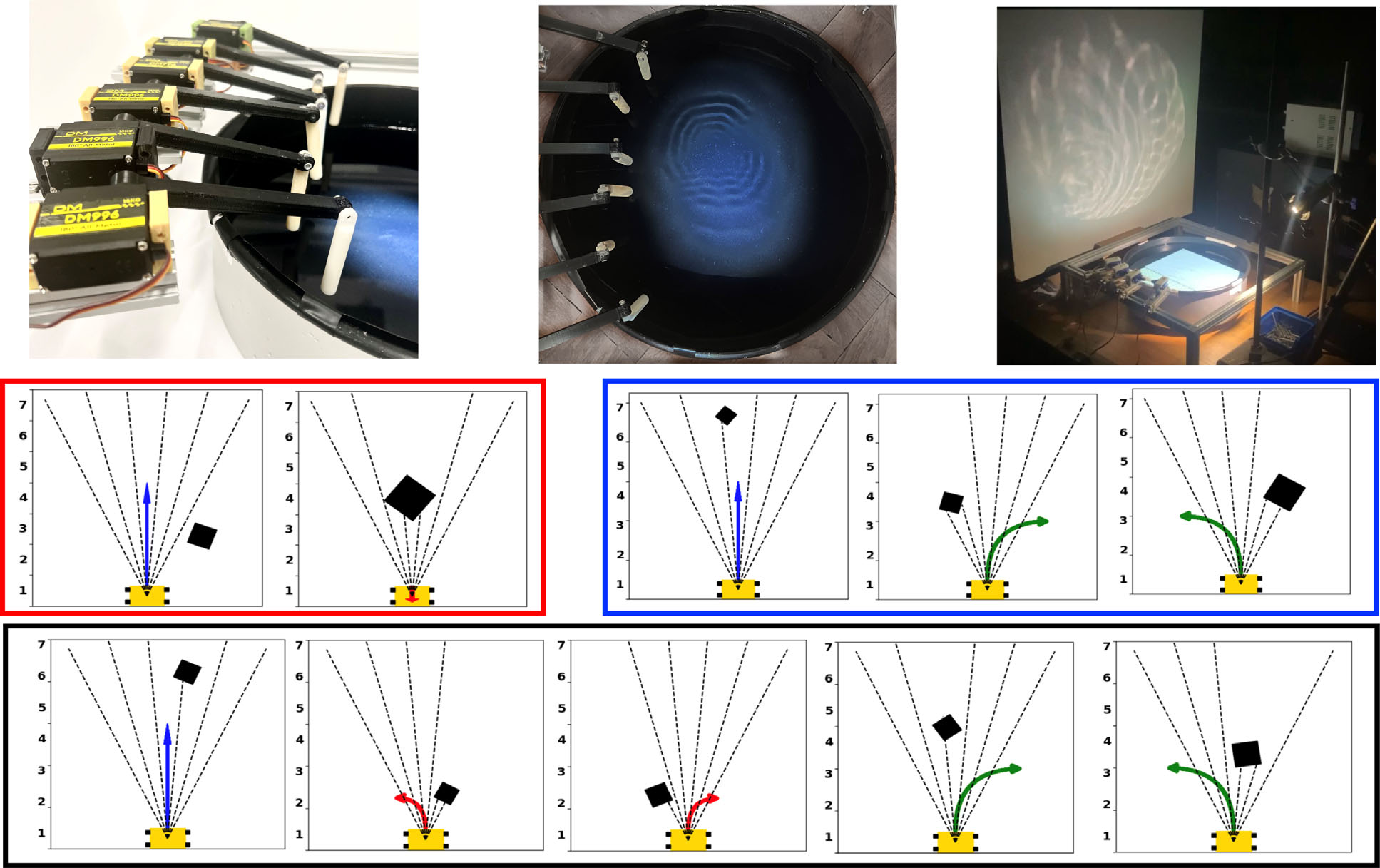
The reservoir computing setup of the robot, image from the original article CC BY 4.0 via Nature Communications
A Swimming Paper-Thin Homunculus: a thin, almost 2-dimensional biorobot created from muscle tissue on fibrin skeleton and actuated by light was shown to swim at a pace of around 4 body lengths per minute (comparable to the cow shark but an order of magnitude slower than the fastest human). Article link.
Techniques for Better Homunculi: the authors demonstrate centimeter-scale soft-bodied robots, in which muscles and scaffolding were optimized with simulation/evolutionary algorithms. The robots are capable of gripping, walking, swimming and exhibiting a large range of motion. Article link.
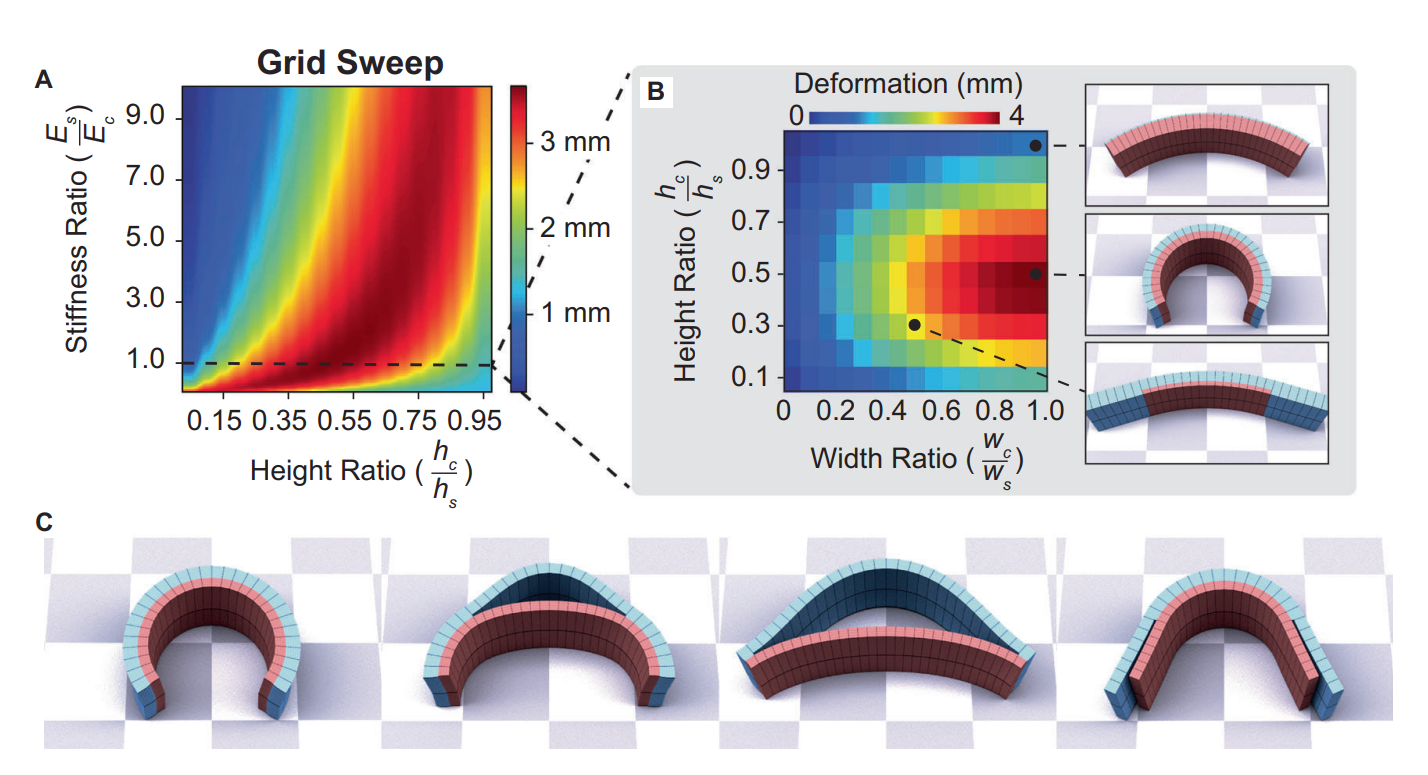
Two layered robotic forms found by optimization, image from the original article CC BY 4.0 via Nature Communications
μUshabti swarm demonstrates hydrokinetic magic: researchers from Cornell, devised a microscopic integrated array of robots capable of sensing temperature and actuation. Those robots were demonstrated to create fluid flow by the means of artificial cilia. Emergent behavior of the array was possible due to leader-follower synchronization mechanisms inspired by fireflies. The researchers report that this is the “first demonstration of microscopic robots changing their physical environment”. Article link.

Egyptian ushabti, photograph by Nevit Dilmen, CC BY-SA 3.0 via Wikimedia Commons
Insect Golems: insect-inspired multimodal robot capable of liftoff, flight, crawling, gliding on water leveraging a reconfigurable shape-memory alloy structure. Each body part was recursively reassigned to different functions, the different modes were exhibited in different scenarios (not one scenario of flight, to lading to crawl to gliding). Article link.
Artificiery Got Another Trick: a pick-and-place machine for running experiments. The machine reconfigured various parts (lasers, lenses, mirrors, cameras) to automate R&D of optics experiments. Article link.
Healing mini-Golem component: Researchers from MIT created safe re-absorbable batteries which could be used to power sensors or medical devices in the GI tract. It’s fully absorbable, can deliver about 1.84V and can operate up to 3 days in the stomach. Article link.
A divining familiar for herbology: A fully integrated AI system combing through Chinese Materia Medica, along with an AutoML system and KAN trying to find novel drug candidates. The conceptual power of the system was validated by experiment in one predicted lipid lowering effect. Article link.
Good Old Herb-Based Pharmacology: Chinese researchers showed that Desmodium styracifolium total flavone capsules promote the expulsion of kidney stones.
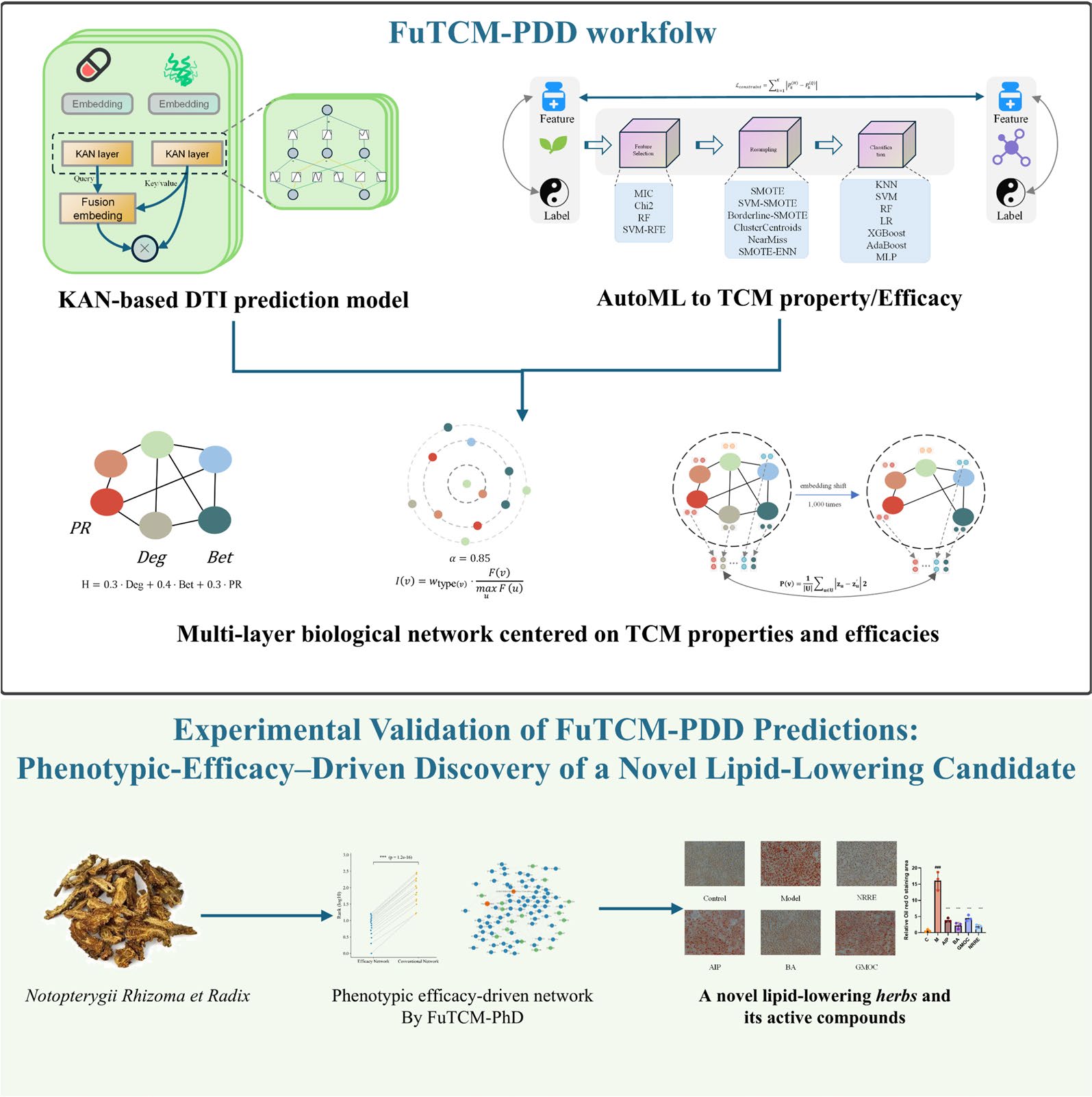 Herb divination via the FuTCM familiar, figure from the original article
CC BY 4.0 via Springer Nature
Herb divination via the FuTCM familiar, figure from the original article
CC BY 4.0 via Springer Nature
Parting Thoughts
The combination of fast iteration speed and research data seems to be potent and was an accidental theme for some of the findings of this month. From wet labs, by Chinese Materia Medica and simulation loops – the true power of computing might just be ruthlessly exhausting the search space.